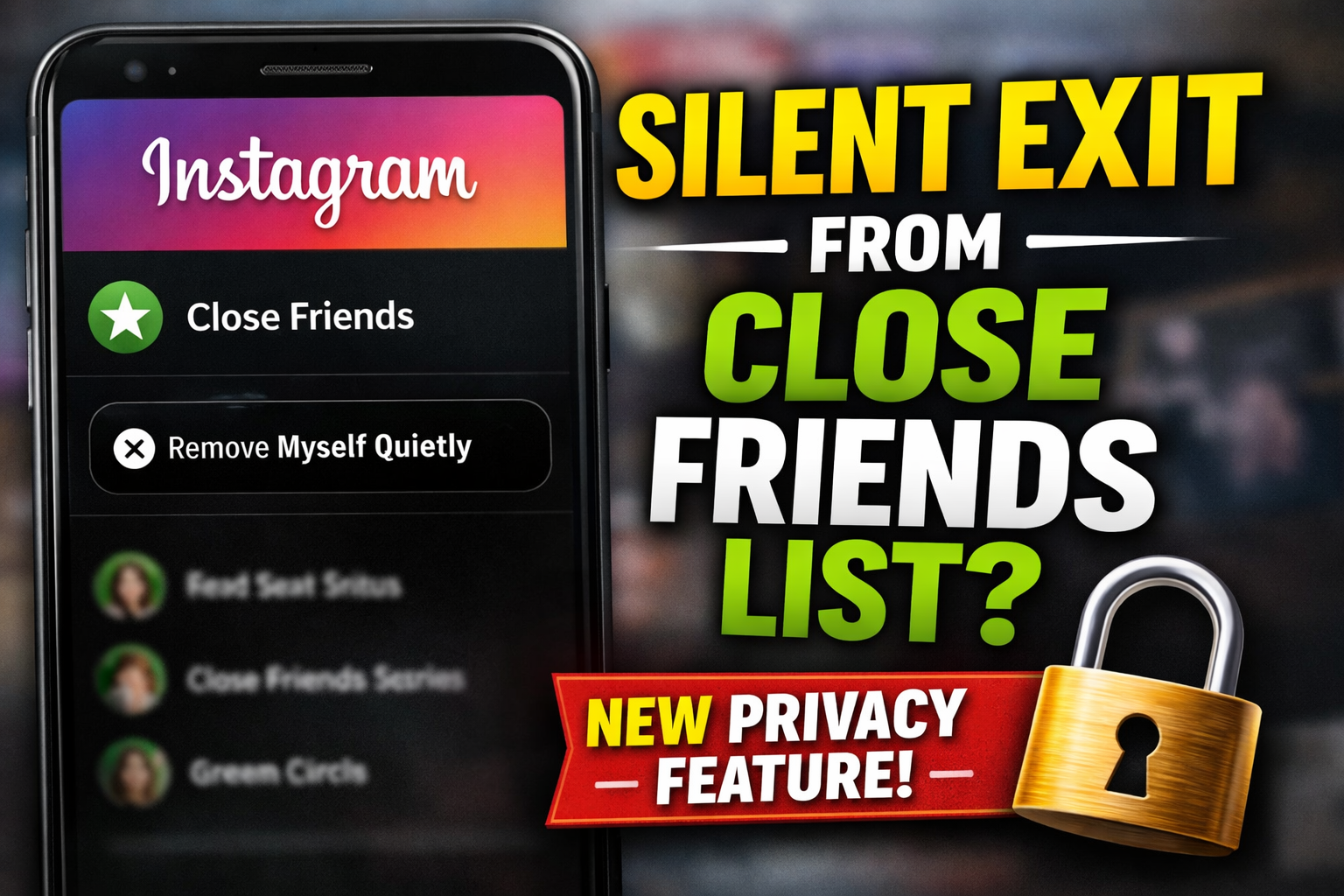
Social media platforms rarely announce their most interesting experiments with a drumroll. Instead, they arrive quietly, noticed first by sharp-eyed users, developers, or testers who stumble upon a new toggle, label, or behavior that wasn’t there yesterday. That’s exactly how the latest Instagram privacy experiment has surfaced — a feature that may soon allow users to remove themselves from someone else’s “Close Friends” list without notifying the other person.
At first glance, this might sound like a tiny tweak. After all, “Close Friends” has been around for years, mostly used for sharing casual updates, personal moments, or content that users don’t want visible to everyone. But when you look deeper, this test says a lot about how social platforms are evolving, how online relationships are changing, and why quiet control is becoming the next big theme in social media privacy.
In this article, we’ll break down:
- What this new feature actually means
- Why Instagram is testing it now
- How it could change user behavior
- The psychology behind “silent exits” on social platforms
- What creators, brands, and everyday users should expect next
And most importantly, we’ll explore why this seemingly small change could have an outsized impact on how comfortable people feel online.
Understanding Instagram’s “Close Friends” Feature
Before diving into the new test, it’s important to understand how Close Friends currently works.
When Instagram introduced Close Friends for Stories, the idea was simple: give users a private circle within a public platform. Instead of posting something for all followers, users could share content only with a selected group marked by a green circle.
Over time, Close Friends became more than just a privacy tool. It turned into:
- A space for unfiltered thoughts
- A place to share daily routines without judgment
- A soft social signal of trust or closeness
Being added to someone’s Close Friends list often meant something. It wasn’t officially labeled that way, but socially, it felt like an invitation into a more personal space.
And that’s exactly where things started getting complicated.
The Unspoken Pressure of Being on Someone’s Close Friends List
Social media doesn’t just connect people — it also creates subtle expectations.
When someone adds you to their Close Friends list, you might feel:
- Obligated to watch their Stories
- Pressured to react or reply
- Awkward if you’re no longer that close
Until now, there has been no clean way to opt out.
If you didn’t want to see someone’s Close Friends Stories anymore, your options were limited:
- Mute them (which feels impersonal)
- Block them (too extreme)
- Unfollow them (socially risky)
- Say something directly (often uncomfortable)
What you couldn’t do was simply step back quietly.
That’s the gap this new feature is trying to fill.
What the New Feature Is Testing (In Simple Terms)
According to early reports and user discoveries, Instagram is testing a feature that lets you remove yourself from another user’s Close Friends list — without sending them a notification.
In practice, this would mean:
- You stop seeing their Close Friends Stories
- They are not alerted about your removal
- No awkward messages, no social fallout
From a user perspective, this is a silent boundary-setting tool.
It’s not about rejection. It’s about comfort.
And that distinction matters.
Why Instagram Is Exploring “Quiet Privacy” Now
To understand why this feature is appearing in 2026 conversations, you have to look at how user behavior has changed over the last few years.
1. Social Media Fatigue Is Real
Users today are overwhelmed by content. Between Stories, Reels, posts, notes, and DMs, attention is constantly pulled in multiple directions. People want less pressure, not more.
2. Online Relationships Are More Fluid
Unlike real-life friendships, online connections don’t always end cleanly. People grow apart, change interests, or simply move on. Quiet exits reflect how modern relationships actually work.
3. Privacy Expectations Are Higher
Users are increasingly aware of:
- Who sees their content
- What they’re expected to engage with
- How their online actions are interpreted
Platforms that offer control without confrontation tend to win trust.
Instagram’s Broader Shift Toward Subtle Control
This experiment doesn’t exist in isolation.
Over the years, Instagram has added several low-drama privacy tools:
- Story muting without notifying users
- Restricting accounts quietly
- Hiding like counts
- Limiting comments without blocking
Each of these features follows the same design philosophy: give users power without creating conflict.
The Close Friends opt-out test fits perfectly into that pattern.
Psychological Impact: Why Silent Features Matter More Than Loud Ones
Human relationships are emotional — even digital ones.
A visible “remove” or notification can:
- Hurt feelings
- Trigger overthinking
- Lead to unnecessary confrontations
A silent option, on the other hand:
- Reduces anxiety
- Encourages honest boundaries
- Makes platforms feel safer
From a psychological standpoint, this kind of feature lowers the emotional cost of self-care.
And when users feel safe, they stay longer.
What This Means for Everyday Instagram Users
If this feature rolls out widely, here’s how it could change daily Instagram use:
More Honest Engagement
People may stop watching content they don’t genuinely enjoy — without guilt.
Less Forced Interaction
No more reacting to Stories just because “they’ll notice if I don’t.”
Cleaner Feeds
Users regain control over what shows up in their Stories tray.
In short, Instagram becomes a little more human.
Impact on Creators and Influencers
For creators, this feature may feel uncomfortable at first.
Close Friends Stories are often used for:
- Behind-the-scenes content
- Personal updates
- Exclusive teasers
If users can quietly remove themselves, creators might see:
- Slightly lower view counts
- More honest engagement metrics
But in the long run, this could actually help creators.
Why? Because the audience that remains is genuinely interested.
Quality over quantity always wins.
Brands and Marketers: A Signal to Rethink “Exclusivity”
Some brands use Close Friends as a pseudo-VIP channel.
This new option suggests:
- Forced exclusivity doesn’t work
- Audiences want choice, not obligation
- Trust matters more than access
Smart brands will respond by:
- Making Close Friends content truly valuable
- Avoiding spammy “exclusive” posts
- Respecting user boundaries
How This Feature Could Change Instagram Culture
Culturally, Instagram has always balanced between:
- Performance
- Authenticity
Features like this push the platform slightly closer to authenticity.
They normalize:
- Quiet exits
- Soft boundaries
- Personal comfort
And that’s a cultural shift worth paying attention to.
Will Instagram Officially Announce This Feature?
If history is any indication, Instagram may:
- Test this quietly with limited users
- Collect feedback and usage data
- Roll it out gradually (or scrap it entirely)
Not every test becomes a permanent feature.
But the fact that Instagram is even exploring this idea tells us something important: user comfort is now a product priority.
What Users Should Do Right Now
At the moment, there’s nothing you need to change or enable manually unless the feature appears in your app.
But this is a good reminder to:
- Review your own Close Friends list
- Be intentional about who you add
- Respect the private nature of the feature
Privacy tools work best when used thoughtfully.
The Bigger Picture: Social Media Is Growing Up
Early social media was loud, public, and reactive.
Modern social media is becoming:
- Quieter
- More personal
- More boundary-aware
This Instagram test reflects a maturing platform responding to a maturing audience.
And that’s a good thing.
Final Thoughts
A silent “remove me” option might not trend on its own. It won’t go viral like a flashy new Reel format or AI tool. But features like this quietly shape how people feel on a platform.
And in the long run, how users feel matters more than any algorithm tweak.
If Instagram does roll this out globally, it could mark another step toward a healthier, less pressured social media experience — one where users don’t have to explain, justify, or announce their boundaries.
Sometimes, the most powerful updates are the ones that let you leave without making noise.
About Instagram
Instagram is a global social media platform owned by Meta, known for its focus on visual content, Stories, Reels, and evolving privacy tools aimed at improving user experience and safety.
Disclaimer
This article is based on early reports, platform testing observations, and evolving feature experiments. Instagram may modify, expand, limit, or discontinue this feature at any time before an official public rollout. Features described here may not be available to all users or regions. This content is intended for informational purposes only.
Leave a Reply